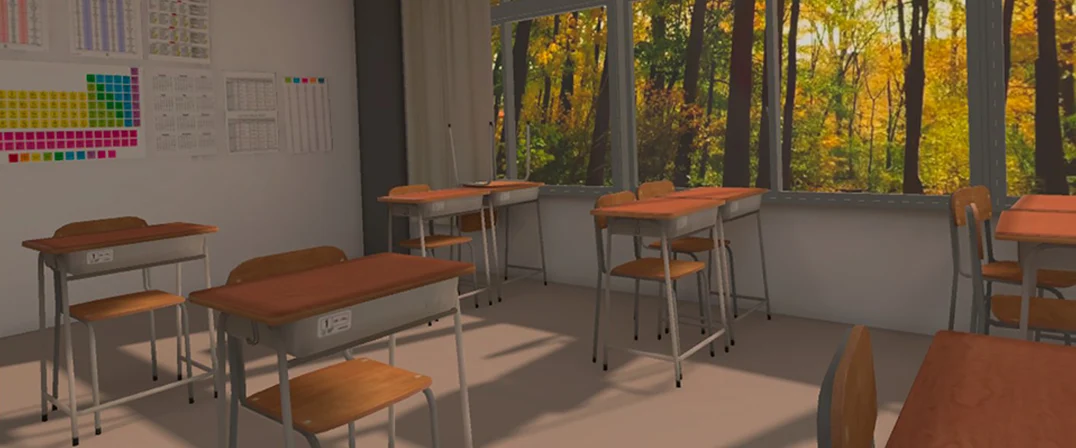
The applications of Virtual Reality (VR) in education can create active experiences in increasingly immersive worlds and provide a safe environment for learners to test and practice situations otherwise stressful or, in some instances, dangerous.
As part of their training, future teachers (students-teachers) are sent out to schools to put into practice what they are learning and work side-by-side with a seeded teacher… who will observe the student-teacher, evaluate their performance and provide feedback to help them hone their craft. The students are also evaluated by their university supervisors. Since this experience takes place in a real classroom, with real students, it can easily become daunting, socially awkward, and very challenging.
In this context and working closely with a team from Concordia’s Teaching English as a Second Language (TESL) unit from the Department of Education and the Lab for Innovation in Teaching and Learning, we created a VR experience where students can prepare, in a safe and customized virtual environment, for their assessment interview with their mentor (either classroom teacher or university supervisor).
Summary of the Experience
The student performs several self-reflective exercises before engaging in a conversation with a mentor, personified through a photorealistic virtual avatar. The student is presented with different ways to respond throughout the discussion. These choices range from being less appropriate to more appropriate. Through this trial-and-error approach, the student can expand and increase their communicative repertoire since they receive immediate feedback on their choices. It is important to note that the student is asked to say their responses out loud throughout the exercise. Their voices are recorded through the VR headset’s microphone so that self-analysis is possible after the experience.
The first phase of this project was to use research methodologies to evaluate the effectiveness of the initial design. Over several months, the VR experience was playtested by three focus groups of current TESL program students from different stages of their studies.
Before doing the simulated practice in VR, the students go through several steps of preparation, which can be briefly summarized below:
- They begin by filling out a questionnaire to evaluate their self-efficacy level
- They are primed through a discussion activity centred around the relationship between a mentor and mentee teacher
- They are briefed on the details of what they will be going through in the VR experience
- They are introduced to the usage of the VR equipment
They proceed to the exercise in VR only when they are fully prepared.
After the VR session, they are invited to revisit the questionnaire to highlight the impact of the experience, and they go through a discussion to reflect on it.
This research-based approach allows us to gather honest feedback from the actual students, allowing the team to develop and finetune the exercise design for maximum effectiveness. The long-term goal is to create an effective, user-tested learning tool that can be deployed on a larger scale to the student population, including those from other universities.
To learn more about this project, please visit the official project page.
Project partners
Project technical note
Type of experience: VR
The VR and TESL Program: The goal was to develop an effective learning tool to help prepare future teachers for receiving feedback from their mentor teachers once they are out in the field.
Length of VR experience: 10-15 minutes
Software and technologies used: The VR experience was developed with the Unity game engine for deployment on the Quest 2 standalone VR headset.